

1 . Scientology E-Meter An E-meter is an electronic device manufactured by the Church of Scientology at their Gold Base production ...
1. Scientology E-Meter
 An E-meter is an electronic device manufactured by the Church of
Scientology at their Gold Base production facility. It is used as an aid
by Dianetics and Scientology counselors and counselors-in-training in
some forms of auditing, the application of the techniques of Dianetics
and Scientology to another or to oneself for the express purpose of
addressing spiritual issues.
An E-meter is an electronic device manufactured by the Church of
Scientology at their Gold Base production facility. It is used as an aid
by Dianetics and Scientology counselors and counselors-in-training in
some forms of auditing, the application of the techniques of Dianetics
and Scientology to another or to oneself for the express purpose of
addressing spiritual issues.E-meter sessions are conducted by church employees known as auditors. Scientology materials traditionally refer to the subject as the “preclear,” although auditors continue to use the meter well beyond the clear level. The preclear holds a pair of cylindrical electrodes (“cans”) connected to the meter while the auditor asks the preclear a series of questions and notes both the verbal response and the activity of the meter. Auditor training describes many types of needle movements, with each having their own special significance.
A 1971 ruling of the United States District Court, District of Columbia (333 F. Supp. 357), specifically stated, “The E-meter has no proven usefulness in the diagnosis, treatment or prevention of any disease, nor is it medically or scientifically capable of improving any bodily function.”
2. Exorcism Cogitz
 Exorcism is the practice of evicting demons or other evil spiritual
entities from a person or place which they are believed to have
possessed (taken control of). The practice is quite ancient and still
part of the belief system of many religions, though it is seen mostly in
the Roman Catholic and Eastern Orthodox Churches.
Exorcism is the practice of evicting demons or other evil spiritual
entities from a person or place which they are believed to have
possessed (taken control of). The practice is quite ancient and still
part of the belief system of many religions, though it is seen mostly in
the Roman Catholic and Eastern Orthodox Churches.Solemn exorcisms, according to the Canon law of the church, can only be exercised by an ordained priest (or higher prelate), with the express permission of the local bishop, and only after a careful medical examination to exclude the possibility of mental illness. The Catholic Encyclopaedia (1908) enjoined: “Superstition ought not to be confounded with religion, however much their history may be interwoven, nor magic, however white it may be, with a legitimate religious rite”.
To listen to two authentic recordings of exorcisms, visit the Top 10 Incredible Recordings. For more audio, video, and images of excorcisms, you can go here.
3. Jewish Kaparot
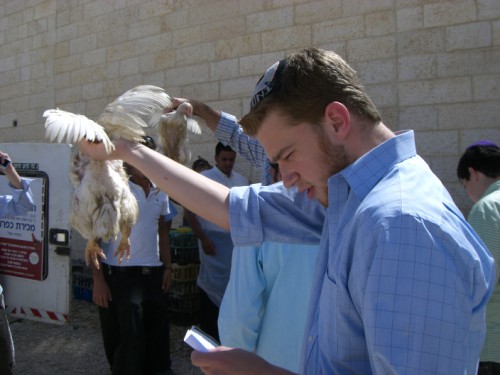 Kaparot is a traditional Jewish religious ritual that takes place
around the time of the High Holidays. Classically, it is performed by
grasping a live chicken by the sholder blades and moving around one’s
head three times, symbolically transferring one’s sins to the chicken.
The chicken is then slaughtered and donated to the poor, preferably
eaten at the pre-Yom Kippur feast. In modern times, Kapparos is
performed in the traditional form mostly in Haredi communities. The
ritual is preceded by the reading of Psalms 107:17-20 and Job 33:23-24.
Kaparot is a traditional Jewish religious ritual that takes place
around the time of the High Holidays. Classically, it is performed by
grasping a live chicken by the sholder blades and moving around one’s
head three times, symbolically transferring one’s sins to the chicken.
The chicken is then slaughtered and donated to the poor, preferably
eaten at the pre-Yom Kippur feast. In modern times, Kapparos is
performed in the traditional form mostly in Haredi communities. The
ritual is preceded by the reading of Psalms 107:17-20 and Job 33:23-24.On the eve of Yom Kippur 2005, more than 200 caged chickens were abandoned in rainy weather as part of a Kaparot operation in Brooklyn, NY; some of these starving and dehydrated chickens were subsequently rescued by the American Society for the Prevention of Cruelty to Animals. Jacob Kalish, an Orthodox Jew from Williamsburg, was charged with animal cruelty for the drowning deaths of 35 of these chickens. In response to such reports of the mistreatment of chickens, animal rights organizations have begun to picket public observances of kaparot, particularly in Israel.
4. Shamanism
 Shamanism refers to a range of traditional beliefs and practices
concerned with communication with the spirit world. There are many
variations in shamanism throughout the world, though there are some
beliefs that are shared by all forms of shamanism. Its practitioners
claim the ability to diagnose and cure human suffering and, in some
societies, the ability to cause suffering. This is believed to be
accomplished by traversing the axis mundi and forming a special
relationship with, or gaining control over, spirits.
Shamanism refers to a range of traditional beliefs and practices
concerned with communication with the spirit world. There are many
variations in shamanism throughout the world, though there are some
beliefs that are shared by all forms of shamanism. Its practitioners
claim the ability to diagnose and cure human suffering and, in some
societies, the ability to cause suffering. This is believed to be
accomplished by traversing the axis mundi and forming a special
relationship with, or gaining control over, spirits.Shamans have been credited with the ability to control the weather, divination, the interpretation of dreams, astral projection, and traveling to upper and lower worlds. Shamans were used in Tibetan Buddhism as a form of divination by which the Dalai Lama was given prophesies of the future and advice.





COMMENTS